An Advanced Design Project on a two-word brief
EcoSonic ran from October 2023 to February 2024 as an Advanced Design Project in the Digital Design master’s programme at HdM Stuttgart, in a team of five, supervised by Prof. Burkhard Fritz and Prof. Bettina Tabel. The brief was two words: Sound and Space.
credits
One theme week, eleven competitors, three experts
A Design Thinking week opened the project with mindmapping across Sound and Space, a first persona, 6-3-5 ideation and a user journey. From there we ran competitor research across eleven existing applications, interviewed a biology student working on invasive species, a forester in Stuttgart and the project lead of a programme restoring 220 water bodies, and built an IST/SOLL diagram that laid every stakeholder and every dependency on one board. Low-fidelity went to the forester, mid-fidelity to the biologist.

We built for testable before we built for viable
We pulled the term MVP apart in a session and settled on minimum testable, usable and lovable as three separate things, then built for testable first. For the AI half that meant Teachable Machine instead of a custom pipeline: forty background samples, twenty-two tree frog calls, seventeen bullfrog calls, and a browser classifying a live microphone signal. It cost days and it answered the question that decided the project, which was whether sound classification carries the concept at all.

The forester rewrote the feature list
We showed the low-fidelity prototype to a forester in Stuttgart, and he widened the brief. He wanted the analogue Wildtierbericht digitised, an email link that forwards a sensitive finding straight to the responsible authority, a comparison of two time periods so trends become visible, and the ability to listen to a detection himself and check the machine. He also told us where the pods belong, which is near water, because that is where the species concentrate. Most of that went into the next version. The biologist then moved the whole application to landscape, because the real device in the field is a ruggedised tablet held standing up.

An “undetermined” state for the AI
The sharpest note came from the forester and concerned a case we had designed around. He asked for an explicit undetermined notification type for a sighting the model cannot assign to a species. That one state changed how far the system can be trusted, because it stops the interface from claiming more certainty than the model has, and it keeps an ambiguous signal visible instead of losing it behind a confidence threshold.
decision 04
The pod has to disappear
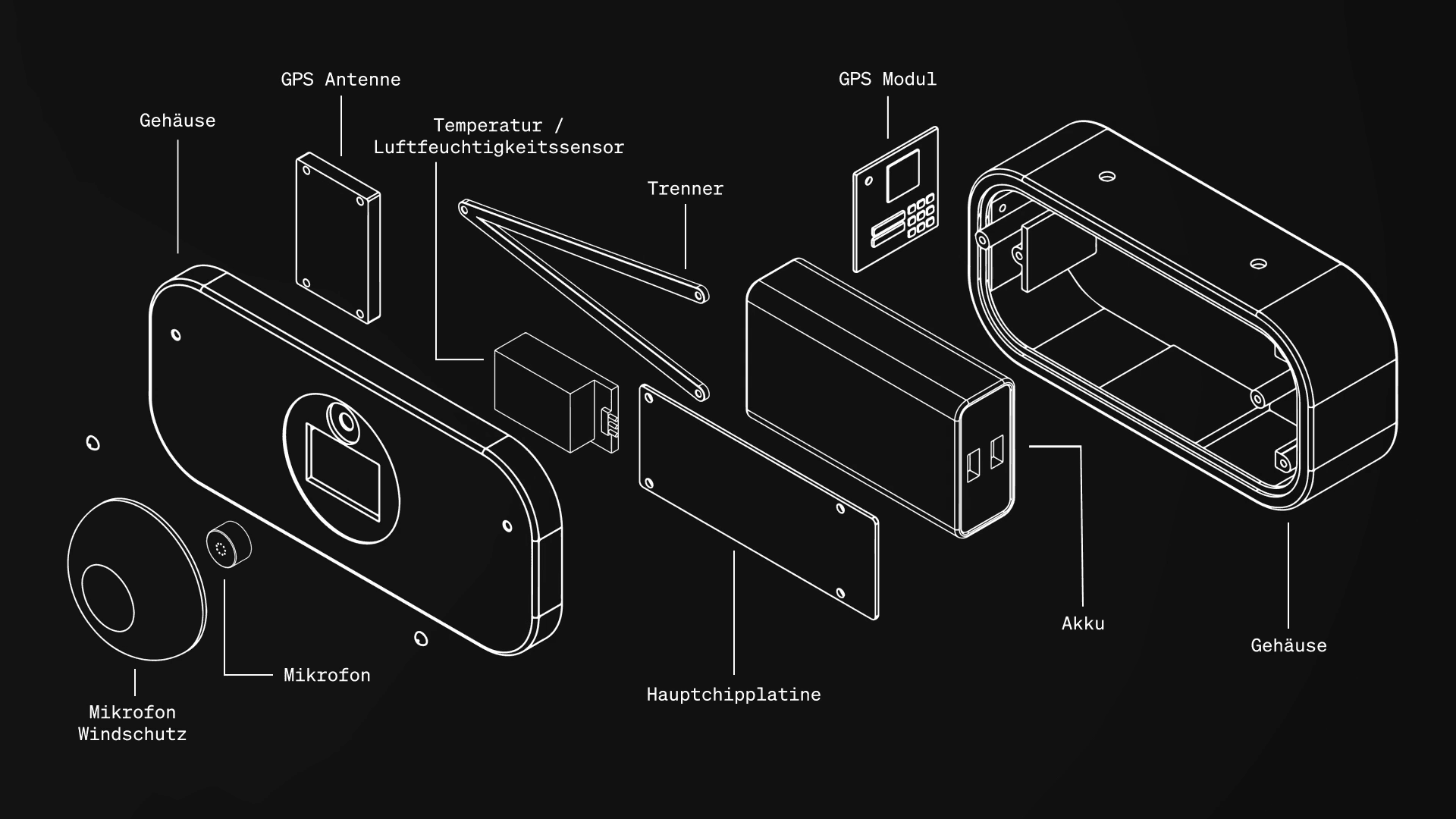
The hardware requirements read like a spec once the forester was done: every signal traceable to a specific pod, an appearance inconspicuous enough to survive theft and vandalism, at least half a year with no human contact, minimal maintenance. The enclosure answers each one. Microphone and the temperature and humidity sensor sit in a hemispherical structure at the front so they reach outside while staying sealed, the back edge is offset by two millimetres for waterproof tape, and screw positions top and bottom let the pod hang from a strap around a tree or mount on a stand.
craft
A map, a timeline, and everything hanging off both
The application opens as a map and stays there. Sections and pods carry a badge when a new detection lands, filters follow the selected area, and a detection card plays the recording before anyone chooses to ignore, observe or forward it. Population density reads as a heat field over the shoreline with a scrubber underneath, so a forester can compare today against three months ago. Temperature and humidity lie over the same map as their own fields, because a cold week explains a quiet week. Navigation took six layouts to settle.

outcome
What stood on the table at MediaNight
Three things existed by 1 February 2024. A working sound classifier built with Teachable Machine and p5.js, running on the visitor’s own phone through a QR code at the stand. A high-fidelity monitoring prototype on an iPad. And a layered landscape model with Arduino buttons along its edge, playing tree frog, bullfrog, birdsong, water and chainsaw into the room, so anyone could hear what the classifier hears and watch it decide.
learnings
Where this stops being a product
The classifier learned from a few dozen clips found online, so it demonstrates the principle and carries no accuracy figure worth quoting. The pods are a CAD model and a rendering, and nothing was built. The process has an honest footnote too. We set up a nine-role board at the start and it quietly stopped mattering, because we ended up distributing work packages instead of roles. That worked, and it was a different method from the one we had planned.