Advanced Design Project 2, third master semester
Captis was an Advanced Design Project in the Digital Design master’s programme at HdM Stuttgart, between March and July 2024, in a team of three with Lea Hammann and André Kling. Some of us had people with the condition in our immediate families, which is why we chose it and how we got access to the people we needed to talk to.
credits
We tracked our own food until we gave up
We ran a survey with six people living with the condition, interviewed several of them, and built a context map. Three quarters of them already used a digital aid. We then took the market leader apart and used it ourselves for a few days, and every one of us abandoned it, frustrated. The critique came out as three words: missing guidance, poor UX, and too much science. An app can be technically correct about histamine content and still be unusable, because nobody keeps up a log that costs this much.

We cut the project down to one phase
After the interim presentation we narrowed the focus onto the provocation phase alone. Elimination is a matter of following a plan, and stabilisation is what comes after. The provocation phase is where the decisions live: which food, how much, when, and what happened in the following three days. Cutting away two thirds of the journey is what made the remaining third worth designing in detail.

voices
„Da steht man auf der Party und hat überall Ausschlag im Gesicht.“
„Ich wusste, ich muss jetzt irgendwas bestellen, wo die mich ganz komisch angucken und denken werden, was hat die für ein Problem?“
One surface instead of five tabs
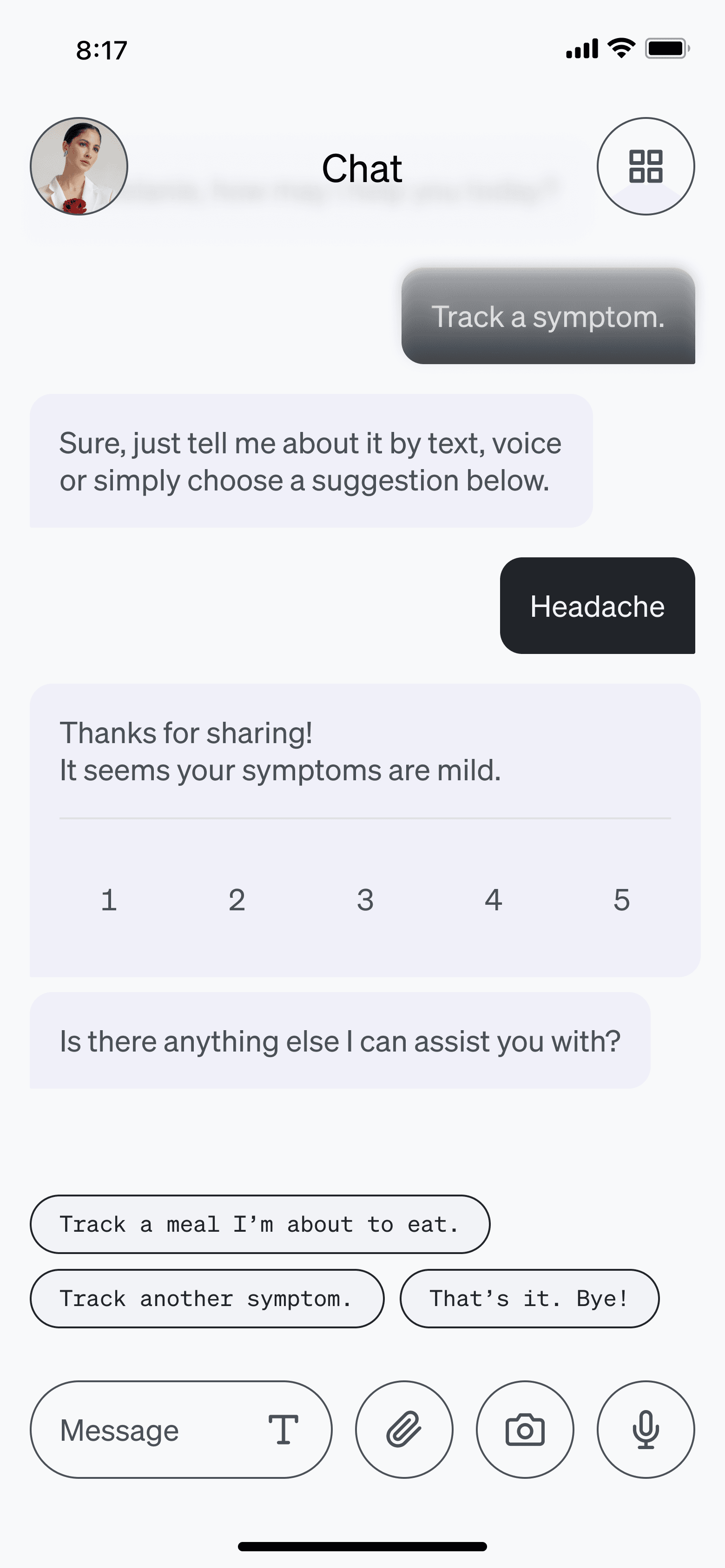
The conventional shape is a tabbed app: diary, symptoms, reports, profile. We put everything into a single conversational interface. Logging a meal, rating a symptom, generating a document and reading the summary all happen in the same thread. Nothing has to be found, so the cost of an entry falls to one message, and a log that runs for years has to cost about that much.

A photo is the entry, language is the correction
A meal is logged by uploading a photo, which the AI reads. Ingredients and details are then confirmed or refined by typing or speaking. The common case costs a tap. An unusual dish or a hidden ingredient costs a sentence. Severity goes in on a five-point scale inside the same bubble, with suggestion chips underneath so the next entry needs no thinking at all.

decision 04
Four principles, and one of them is tone
We wrote down four design principles and held the interface to them: simplified to the max, individualised and contextual, friendly, trustworthy. The last two are about voice. An app that reads like a lab report makes people feel like patients, and the research had already shown us that the heaviest part of this condition is social. Clear language, few colours, and a system that answers rather than reports.
decision 05
We stopped prototyping and built the agent
The plan was to wire the API into a ProtoPie prototype. We hit its limits quickly and changed course, building an actual agent on GPT-4o for its ability to read image, audio and video. That meant deriving a general formula for GPT instructions, covering purpose, objectives, capabilities, interaction guidelines, personalisation, limits, and how to refuse what falls outside the scope. The knowledge base came from the SIGHI lists. Test users then fed it real data for weeks, and by the end it was producing provocation reports we could read.
craft
A small system, mostly built for one screen
Colours, type, buttons, forms, pagination and dropdowns as the base, deliberately kept narrow, then extended with the parts a conversation actually needs: chat bar, speech bubbles, chat microinteractions, documents, food tracking, the wellbeing flow, an AI speech animation, an AI chat animation, and a thinking state. Microanimations were specified alongside the components rather than added later, because in a chat the waiting is part of the interface.
outcome
An agent in public and a forty-day story
Two working things and a story that connects them. A public GPT agent, which spent weeks being fed by real users and generating reports from what it learned. And a clickable high-fidelity prototype that walks a 40-day story: add a provocation by photographing a pizza, confirm the ingredients by voice, log the mood, generate a shopping list for the health food store, close the day. Both stood on the table at MediaNight next to an ad film, and visitors tested them with task cards.
live
THE AGENT IS STILL RUNNING
The proof of concept went public and stayed public. It carries the SIGHI food lists as its knowledge base and a set of instructions we wrote ourselves, and it will track a meal for you right now.
learnings
The test we did not run
We worked closely with people who have the condition and learned a lot from them. What we never did, for lack of time, is a proper user test of the finished prototype, and that is the first thing I would do next. Three questions stayed open and they are the interesting part: what highly contextual, personalised AI does to how people use apps at all, whether separate apps survive it, and what a future without them would mean for privacy and for competition.